
When AI systems begin making decisions, rules alone are not enough. Context Graphs preserve reasoning—not just outcomes—making autonomous agents explainable, accountable, and continuously improving.
In our previous issue, we explored how AI systems are evolving from tools into operational actors. Once systems begin interpreting objectives, evaluating alternatives, and acting with limited supervision, governance models built for deterministic software begin to strain. Rules define boundaries and enforce consistency. They do not preserve judgment.
As AI systems transition from executing instructions to making decisions, a deeper requirement emerges: retaining not only what was executed, but why it was chosen.
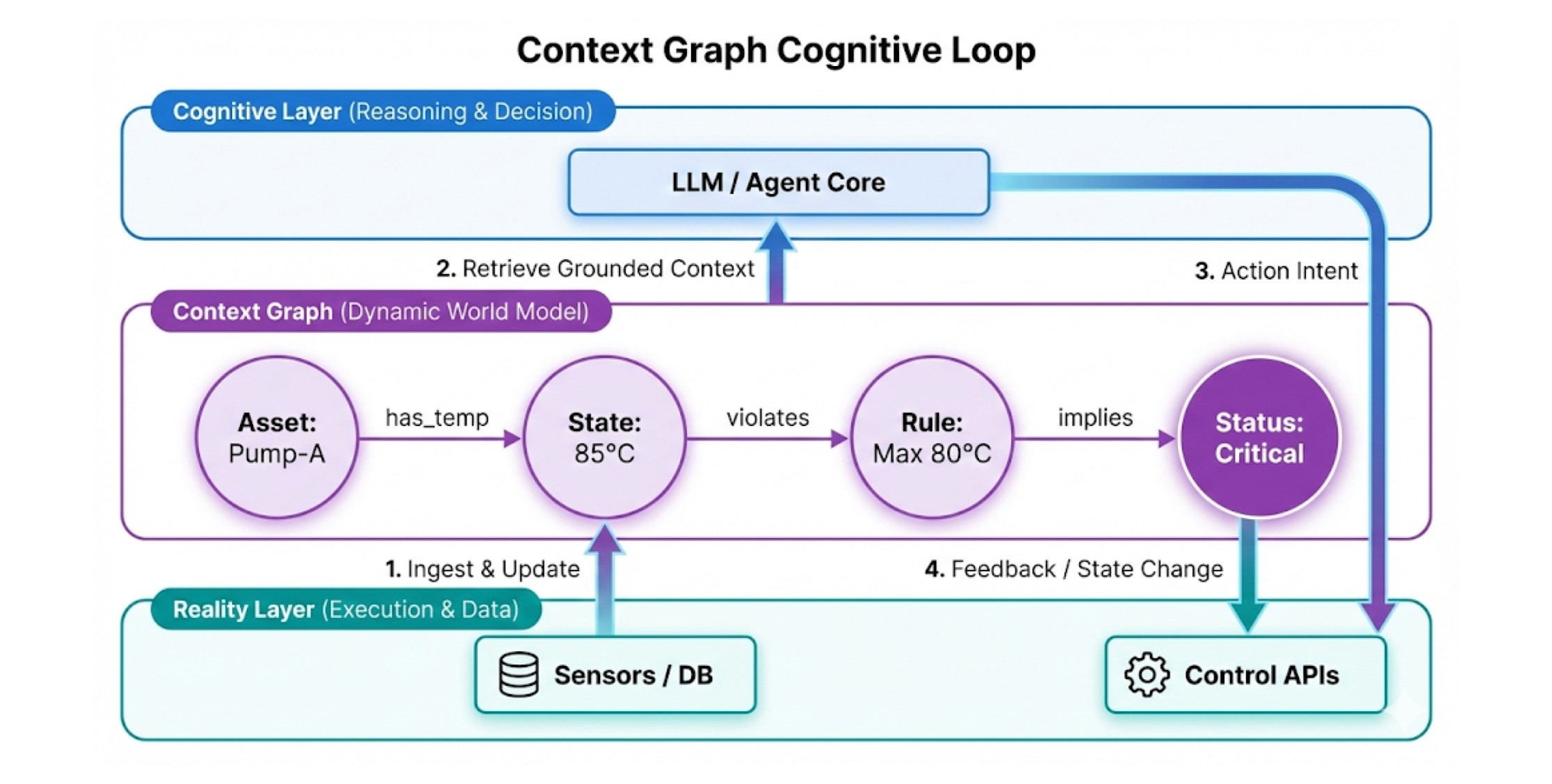
A Context Graph treats decisions as first-class system objects rather than transient execution artifacts. Instead of storing only final outputs, it preserves the decision environment in which those outputs were produced, including the triggering context, relevant entities, applied constraints, evaluated alternatives, and the reasoning behind the selected path. These elements are structurally connected across time and outcomes to form a persistent memory layer.
Unlike traditional data models that record what happened, or rule engines that define what is allowed, a Context Graph preserves how judgment was formed. That distinction becomes critical once AI systems begin acting with autonomy rather than simply executing predefined logic.
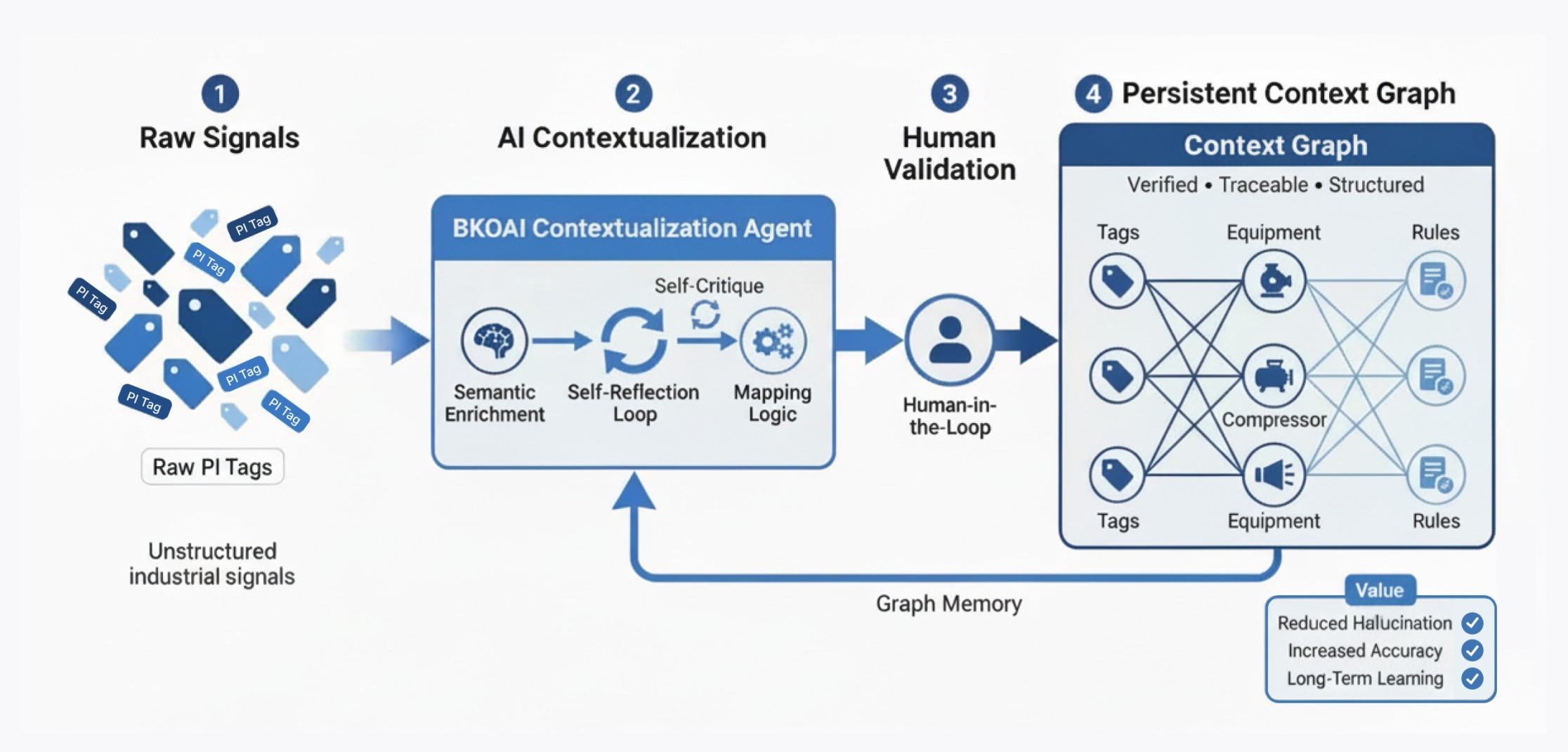
Industrial PI tag-to-equipment mapping illustrates this challenge clearly. The task is rarely deterministic. Tags may be ambiguous, equipment hierarchies inconsistent, and contextual signals incomplete. A contextualization agent must interpret meaning, evaluate multiple candidate mappings, apply operational constraints, and reflect before finalizing an assignment.
If only the final mapping result is stored, the logic behind rejected alternatives and resolved ambiguities disappears. Future mappings then repeat interpretive cycles that the organization has already resolved. Accuracy becomes dependent on model inference rather than accumulated organizational judgment.
By preserving the triggering context, evaluated candidates, applied constraints, and human validation feedback within a structured Context Graph, the reasoning path becomes durable. The graph evolves into a long-term memory layer that future mappings can reference. The result is not merely higher precision, but continuity. Decisions become explainable not only in outcome, but in logic.
Rules enforce compliance. Memory preserves intent. As AI systems begin deciding rather than merely executing, continuity of judgment becomes a structural requirement rather than an operational enhancement.
Without preserved reasoning, autonomy remains brittle. With decision memory, intelligence compounds rather than resets.
In the next issue, we examine how this continuity of judgment changes agent behavior itself, using Root Cause Analysis to show how memory transforms reactive automation into accumulated diagnostic intelligence.

